Top Header Menu

Tag Archives | Featured-Neurofeedback

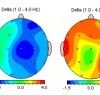
Figure 4 (click to enlarge):  Pre- and Post-treatment NeuroGuide QEEG maps (eyes open) showing effects of 23 sessions of 4-channel Multivariate Proportional live Z-Score training.

Whole-Head Normalization Using Live Z-Scores For Connectivity Training (Part 2)

This article is a second in a 2-part series that further explains the practicalities of using Z-score [neurofeedback] training with multiple sites. For an explanation of the theory this is based upon, please refer to Part 1 of this series. Additionally, readers not familiar with Z-score neurofeedback may want to first read the article “Z-Score […]

Continue Reading 0
multivariate_Z-Score_display

Whole-Head Normalization Using Live Z-Scores For Connectivity Training (Part 1)

This article relates some of our last 2 years of work with Live Z-score [neurofeedback] Training (LZT), and how the methods and clinical experience have evolved.  Starting with the simple use of live Z-scores to view EEG parameters and do simple training, we have evolved the practice into a comprehensive multichannel whole-head approach with an […]

Continue Reading 0
neurofeedback_migraine_figure1small

A Clinical Outcome Study Of Neurofeedback And Biofeedback For Migraine Headache

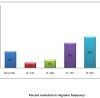
In a recent meta-analysis involving biofeedback for the treatment of migraine, Grade A evidence [6] was found for the efficacy of the above methods which proved stable over a 17 month follow-up phase [5]. Numerous studies explore peripheral biofeedback [5], but scant studies exist on using neurofeedback methods to treat migraine [7-11]. Although the current […]

Continue Reading 0
faces_of_combat_cover

Eric Newhouse’s Crusade To Improve Veterans’ Access To Much Needed PTSD And TBI Treatments, Including Neurofeedback And CES

Pulitzer Prize winning journalist Eric Newhouse illuminates the dire circumstances that veterans with post-traumatic stress disorder (PTSD) and traumatic brain injury (TBI) frequently encounter in his book, “Faces of Combat, PTSD and TBI: One Journalist’s Crusade to Improve Treatment for Our Veterans.”

Continue Reading 0
Fig. 1 - JTFA normative databases are instantaneous and include within-session variance plus between-subject variance.  In contrast, FFT normative data only contains between-subject variance.  t = time, s = subjects and SDt = standard deviation  within-session and SDs = standard deviation between subjects.  Thus FFT Z scores are larger than JTFA Z scores and a ratio of 2:1 is not uncommon.  (From Thatcher et al, www.appliedneuroscience.com).

Z-Score EEG Biofeedback: Conceptual Foundations

The fundamental design concept of Z score biofeedback [also known as Z-Score neurofeedback] was first introduced in 1998 (Thatcher, 1998; 1999; 2000a; 2000b). The central idea of the instantaneous Z score is the application of the mathematical Gaussian curve or ‘Bell Shaped’ curve by which probabilities can be estimated using the auto and cross-spectrum of […]

Continue Reading 0
neurons_networked

Neurofeedback Benefits People With Treatment Resistant Epilepsy

In a soon-to-be published meta-analytic study*, researchers report that neurofeedback benefits people with treatment refractory (resistant) epilepsy. The authors’ review of current research revealed that almost 50 million people worldwide have epilepsy, or 0.8% of the general population, and that approximately 33% of patients with this unfortunate medical condition do not benefit from traditional medical […]

Continue Reading 1
pills

An Overview Of Alpha-Theta Neurofeedback And Its Treatment Effectiveness For Substance Abuse

Neurofeedback, also known as EEG biofeedback, has been used successfully for the treatment of substance abuse for over 25 years. Built on the work of Kamiya and Green (Budzynski, 1999), Eugene Peniston published a series of papers using alpha-theta neurofeedback with a Veteran’s Administration (VA) population of Vietnam War veterans diagnosed with alcohol abuse and […]

Continue Reading 0
Berman_Figure5_small

Neurofeedback For Dementia Improves Executive Functioning and Memory In A Small Pilot Study

The results of an ongoing unpublished clinical trial* provides initial evidence that neurofeedback may significantly improve some components of memory and executive functioning in persons with dementia. The investigators want to expand this pilot study into a large clinical trial and seek additional participants (contact information is provided below). Berman et al.’s review of prior […]

Continue Reading 0

Proudly hosted by Lightning Base