 There is an increasing awareness of the role that mental health support and self-help groups play in recovery from mental illnesses. Mental health support and self-help groups, historically considered as an alternative to traditional mental health treatment, are now recognized as partners in the continuum of mental health care*. The National Survey on Drug Use and Health (NSDUH)** gathers information that can help provide a better understanding of the extent to which these groups are used, the characteristics of the people who use them, and the relationship between the more traditional modes of mental health treatment and mental health support or self-help groups. The characteristics of adults (i.e., persons aged 18 or older) who received treatment, counseling, or support for emotions, nervousness, or mental health in the past year from an in-person support or a self-help group (support and self-help groups hereafter are referred to collectively as self-help groups) from 2005-2008 are examined.
Mental Health Support and Self-Help Groups

Table 1. Percent Distribution of Adults Aged 18 or Older Who Received Support from a Mental Health Self-Help Group in the Past Year and of the Total Adult Population, by Demographic Characteristics: 2005 to 2008
Traditional Mental Health Treatment and Mental Health Self-Help Groups
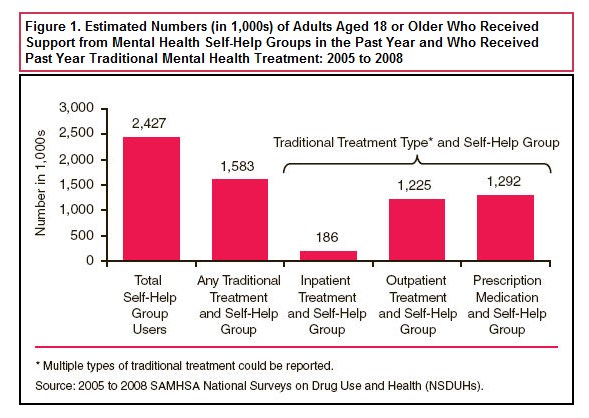
Figure 1. Estimated Numbers (in 1,000s) of Adults Aged 18 or Older Who Received Support from Mental Health Self-Help Groups in the Past Year and Who Received Past Year Traditional Mental Health Treatment: 2005 to 2008
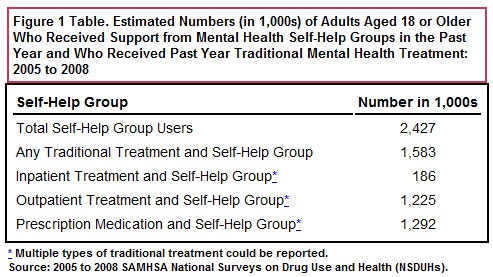
Figure 1 Table. Estimated Numbers (in 1,000s) of Adults Aged 18 or Older Who Received Support from Mental Health Self-Help Groups in the Past Year and Who Received Past Year Traditional Mental Health Treatment: 2005 to 2008
Mental Health Self-Help Group Use among Recipients of Traditional Treatment
About 5.5 percent of adults who received any traditional type of mental health treatment in the past year also received support from a mental health self-help group in that time period. Use of self-help groups was reported by 9.8 percent of those who received inpatient mental health care in the past year, 8.2 percent of those who got outpatient care, and 5.3 percent of those treated with prescription medications. The proportion using self-help groups was 8.8 percent among adults who received two or more of these traditional types of mental health care and 14.2 percent among those who received all three types.
Demographic Differences in Use of Self-Help Groups among Treatment Recipients

Figure 2. Received Support from a Mental Health Self-Help Group in the Past Year among Adults Aged 18 or Older Who Received Past Year Traditional Mental Health Treatment, by Age Group: 2005 to 2008

Figure 2 Table. Received Support from a Mental Health Self-Help Group in the Past Year among Adults Aged 18 or Older Who Received Past Year Traditional Mental Health Treatment, by Age Group: 2005 to 2008
Discussion

Figure 3. Received Support from a Mental Health Self-Help Group in the Past Year among Adults Aged 18 or Older Who Received Past Year Traditional Mental Health Treatment, by Race/Ethnicity: 2005 to 2008
The National Survey on Drug Use and Health (NSDUH) is an annual survey sponsored by the Substance Abuse and Mental Health Services Administration (SAMHSA). The combined 2005 to 2008 data used in this report are based on information obtained from 182,332 persons aged 18 or older. The survey collects data by administering questionnaires to a representative sample of the population through face-to-face interviews at their place of residence.
These materials were adopted from: Substance Abuse and Mental Health Services Administration (SAMHSA).
References:
*Goldstrom, I. D., Campbell, J., Rogers, J. A., Lambert, D. B., Blacklow, B., Henderson, M. J., & Manderscheid, R. W. (2006). National estimates for mental health mutual support groups, self-help organizations, and consumer-operated services. Administration and Policy in Mental Health, 33, 92-103.
**Substance Abuse and Mental Health Services Administration, Office of Applied Studies. (October 8, 2009). The NSDUH Report: Mental Health Support and Self-Help Groups. Rockville, MD.
No comments yet.