 Since the 1980s, a high EEG abnormality rate has been reported for patients with panic disorder. However, how the EEG abnormalities are related to the clinical features and pathology of these patients has yet to be clarified. On the other hand, the risk of diagnosing panic disorder as epilepsy has been pointed out. In this study, researchers investigated whether or not EEG abnormalities are related to the 13 symptoms in the DSM-IV criteria for a diagnosis of panic attacks. Check the end of this report for a link to download this open access study.
Methods
The participant sample consisted of 70 patients diagnosed with panic disorder. Logistic regression analysis was performed with EEG findings as dependent variables and age, sex and with or without the 13 symptoms as independent variables.
EEG Recording
For EEG record, Nihon Kohden EEG-1514 leads were attached to both earlobes (A1 and A2). The reference electrode was 12 channels: Fp1, Fp2, C3, C4, P3, P4, 01, 02, F7, F8, T3 and T4, according to the international 10-20 system of Electrode Placement, and the EEG was recorded for 15 consecutive minutes or more. The bipolar leads were 12 channels: Fp1-F3, Fp2-F4, F3-C3, F4-C4, C3-P3, C4-P4, P3-01, P4-02, Fp1-F7, Fp2-F8, F7-T3 and F8-T4, and the EEG was recorded for 2 consecutive minutes or more. Photic stimulation was given at 10 second intervals at 3, 5, 6, 8, 10, 12, 14, 15, 18, 20 and 24 Hz, and hyperventilation was carried out for 5 minutes at 3 second intervals.
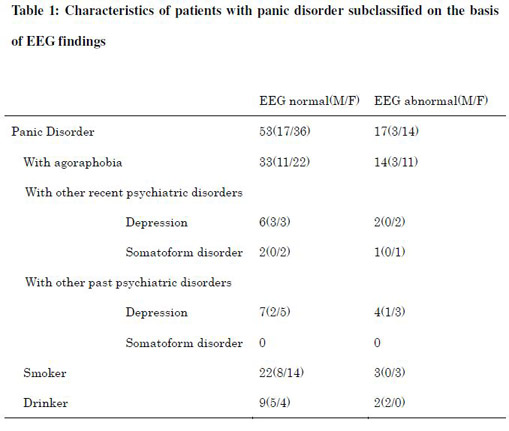
Table 1: Characteristics of patients with panic disorder subclassified on the basis of EEG findings. (click to enlarge)
EEG Recording Interpretation Criteria
EEG record reading was based on the decision criteria of adult EEG proposed by Teruo Ohkuma in 1999, which are widely accepted in Japan. The criteria details are 1) EEG with eyes closed is composed of alpha or faster activity than alpha. Obvious theta and delta waves do not appear. 2) alpha waves and fast activity show normal localization. 3) There is no difference of 20-30% or more in the amplitude of symmetric parts. 4) There is no difference of 10% or more in the duration of symmetric parts. 5) alpha attenuation occurs with open eyes, sensory stimuli, and mental activities 6) Neither alpha nor fast activity show abnormally high amplitude. 7) No intermittent activities appear, such as spike waves or sharp waves (intermittent abnormal activity, epileptic pattern).

Table 2: EEG abnormal findings of 17 cases (click to enlarge)
Results
17 of the 70 participants evidenced EEG abnormalities. There were no significant difference with agoraphobia, psychiatric disorders, drinker, and smoker or not (Table 1). Of the 17 with EEG abnormalities, 13 had repeated slow waves in the theta-band – the most prevalent EEG abnormality found in this study. Paroxysmal abnormality interpreted as epileptiform was found in only two cases. Additionally, nausea or abdominal distress (37.7% vs 82.45%, OR-12.5), derealization or depersonalization (7.5% vs 47.1%, OR=13.9), and paresthesias (43.4% vs 64.7%, OR=7.9) were extracted by multivariate analysis as factors related to EEG abnormalities.
Conclusion
Of the 70 patients studied, 17 had EEG abnormalities. Among these 17 cases, “repeated slow waves in the theta-band” was the most common abnormality. Only two out of the 70 cases examined had epileptiform discharges. The factors identified as being related to EEG abnormalities are nausea or abdominal distress, derealization or depersonalization, and paresthesias. The study indicated that physiological predispositions symbolized in EEG abnormality are closely related to panic attacks.
Download/Material adapted from:
Hayashi, Karin and Makino, Mariko and Hashizume, Masahiro and Nakano, Koichi and Tsuboi, Koji (2010). EEG abnormalities in panic disorder patients: a study of symptom characteristics and pathology. BioPsychoSocial Medicine, 4, 1.
This was a more traditional assessment of the EEG, but I found these results interesting nonetheless. I wish the authors compared the the patient EEGs to a normative database. A normative database comparison might have provided additional important information about EEG abnormalities in patients with panic disorder.