Top Header Menu

Tag Archives | Epilepsy

illustration of brain electrical fields

Weak Electrical Fields In The Brain Help Neurons Fire Together

The brain – awake and sleeping – is awash in electrical activity, and not just from the individual pings of single neurons communicating with each other. In fact, the brain is enveloped in countless overlapping electric fields, generated by the neural circuits of scores of communicating neurons. The fields were once thought to be an […]

Continue Reading 0
mother holding her infant

Maternal Depression Adversely Affects Quality Of Life In Children With Epilepsy

A study by Canadian researchers examined the prevalence of maternal depression and its impact on children newly diagnosed with epilepsy. Prevalence of depression in mothers ranged from 30% to 38% within the first 24 months following a child’s epilepsy diagnosis. The mother’s depressive symptoms negatively impacted the child’s health-related quality of life, but the effects […]

Continue Reading 0
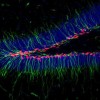
Deep brain stimulation of the anterior thalamic nucleus in the mouse brain results in an increase in the number of new neurons due to an increase in cell division in the mouse hippocampus, specifically among neural stem (green) and progenitor cells (pink). (Credit - Grigori Enikolopov at CSHL)

Scientists Identify Elusive Neuronal Targets Of Deep Brain Stimulation

Shooting steady pulses of electricity through slender electrodes into a brain area that controls complex behaviors has proven to be effective against several therapeutically stubborn neurological and neuropsychiatric disorders. Now, a new study has found that this technique, called deep brain stimulation (DBS), targets the same class of neuronal cells that are known to respond […]

Continue Reading 0
An illustration of how individual cortical nerve cells controlled thought

Controlling Individual Cortical Nerve Cells By Human Thought

Five years ago, neuroscientist Christof Koch of the California Institute of Technology (Caltech), neurosurgeon Itzhak Fried of UCLA, and their colleagues discovered that a single neuron in the human brain can function much like a sophisticated computer and recognize people, landmarks, and objects, suggesting that a consistent and explicit code may help transform complex visual […]

Continue Reading 1

Proudly hosted by Lightning Base